
Recently, more and more new players came to practices. Under my observation, I found some of them were not familiar with basketball rules. In order to become an excellent basketball player, the first thing you should learn are the basic rules for this sport. I hope this blog can help the new members to learn what they should do or shouldn’t do during the game.

Fouls and Violations
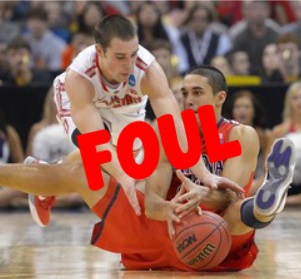
Fouls
- Hitting
- Pushing
- Slapping
- Holding
- Illegal pick/screen: When an offensive player sticks out a limb and makes physical contact with a defender in an attempt to block the path of the defender.
- Personal foul penalties: If a player is shooting while being fouled, then he gets two free throws if his shot doesn’t go in, but only one free throw if his shot does go in.
- Three free throws are awarded if the player is fouled while shooting for a three-point goal and they miss their shot. If the player makes it anyway, he is awarded one free throw.
- Inbounds: If fouled while not shooting, the ball is given to the team the foul was committed upon. They get the ball at the nearest side or baseline, out of bounds, and have 5 seconds to pass the ball onto the court.
- Five or more fouls per quarter: If the team committing the foul has five or more fouls in one quarter, then the fouled player receives two free throws.
- Charging:An offensive foul that is committed when a player pushes or runs over a defensive player. The ball is given to the team that the foul was committed upon.
- Blocking: it is illegal personal contact resulting from a defender not establishing position in time to prevent an opponent’s drive to the basket.
- Flagrant foul: Violent contact with an opponent. This includes hitting, kicking, and punching. This type of foul results in free throws plus the offense retaining possession of the ball after the free throws.
- Intentional foul: When a player makes physical contact with another player with no reasonable effort to steal the ball. It is a judgment call for the officials.
- Technical foul: A player or a coach can commit this type of foul. Foul language, obscenity, obscene gestures, and even arguing.
Violations
- Walking/Traveling: Taking more than ‘a step and a half’ without dribbling the ball or moving your pivot foot once you’ve stopped dribbling.
- Carrying/palming: When a player dribbles the ball with his hand too far to the side of or, sometimes, even under the ball.
- Double Dribble:Dribbling the ball with both hands on the ball at the same time or picking up the dribble and then dribbling again.
- Held ball: Occasionally, two or more opposing players will gain possession of the ball at the same time. The referee stops the action and awards the ball to one team or the other on a rotating basis.
- Backcourt violation: Once the offense has brought the ball across the mid-court line, they cannot go back across the line during possession. If they do, the ball is awarded to the other team to pass inbounds.
- Time restrictions: A player passing the ball inbounds has five seconds to pass the ball. If he does not, then the ball is awarded to the other team. Other time restrictions include the rule that a player cannot have the ball for more than five seconds when being closely guarded and, shot-clock restrictions requiring a team to attempt a shot within 24 seconds.
Player positions

- Center: They are generally your tallest players. They generally are positioned near the basket.
- Forward: The next tallest players in the team will most likely be forwards. While a forward may be called upon to play under the hoop, they may also be required to operate in the wings and corner areas.
- Guard: These are potentially your shortest players and they should be really good at dribbling fast, seeing the court, and passing. It is their job to bring the ball down the court and set up offensive plays.
Reference: https://www.breakthroughbasketball.com/basics/basics.html
 Pinghe Huskies